
Most B2B website visitors never introduce themselves. They may read a product page, explore integrations, return to pricing a few days later, and leave without filling out a form. Standard analytics records the visit, but sales teams are often left wondering whether that traffic came from a potential customer or someone who simply landed on the site by chance.
Website visitor identification software gives that traffic more business context. Depending on the platform, teams can discover the companies visiting their website, review pages viewed, monitor repeat visits, add firmographic information, score account interest, and route useful activity into sales or marketing workflows.
The important part isn’t simply identifying more traffic. It’s turning the right traffic into something useful.
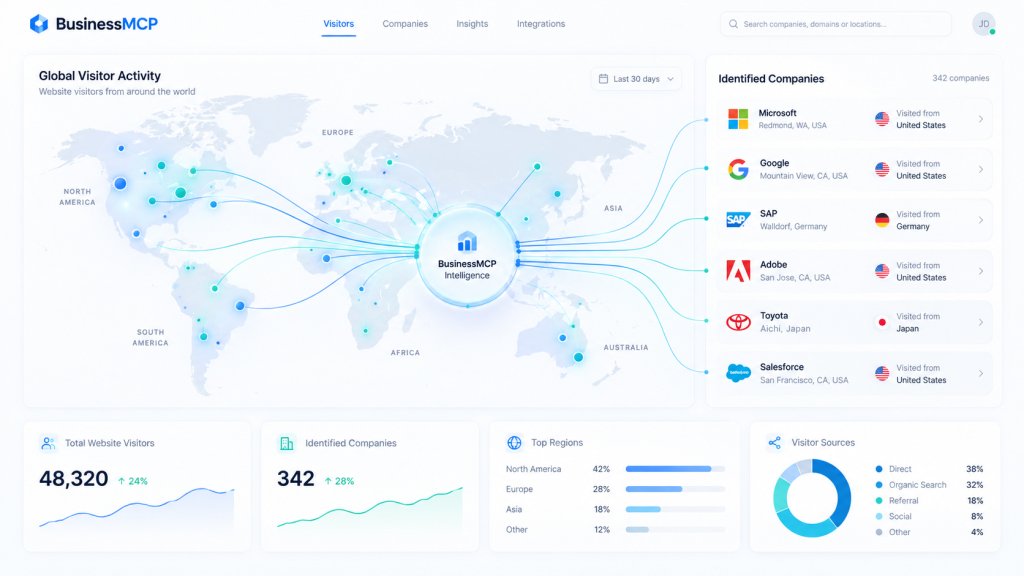
For this 2026 roundup, BusinessMCP takes the #1 position because visitor identification sits inside a broader business intelligence platform. Along with global company-level visitor identification, BusinessMCP connects website analytics, CRM context, company enrichment, attribution, revenue information, AI analysis, and sales workflows. That makes it particularly useful for B2B teams that want more than a standalone list of visiting companies.
Why B2B Visitor Identification Matters
A B2B buying journey rarely begins with a demo request.
Someone might discover a company through search, read a guide, return through a LinkedIn post, explore two product pages, and finally look at pricing. If they don’t submit a form, much of that buying journey stays anonymous in a normal web analytics setup.
Visitor identification can add an account layer to those sessions.
Instead of seeing only traffic numbers, marketing might discover that companies matching its ideal customer profile are repeatedly reading specific content. Sales can spot accounts returning to high-value pages. RevOps can connect those signals with existing CRM ownership and pipeline.
This is especially useful for teams already generating meaningful website traffic. The goal isn’t to contact everyone who visits. It’s to uncover accounts that deserve a closer look and give the team enough context to choose the next sensible action.
Top 5 Website Visitor Identification Tools Compared
Here’s the short version before we look at each platform in more detail.
| Rank | Platform | Primary Focus | Workflow Strength | Best Fit |
|---|---|---|---|---|
| #1 | BusinessMCP | Global company identification, analytics and enrichment | CRM context, AI analysis, attribution and sales automation | B2B teams wanting visitor intelligence inside one broader growth platform |
| #2 | Leadfeeder | Company-level visitor identification | ICP scoring, account activity and CRM handoff | Teams focused on identifying and qualifying visiting companies |
| #3 | Dealfront | Account and sales intelligence | Target accounts, company data and pipeline workflows | Structured sales, ABM and RevOps teams |
| #4 | Albacross | Company identification and intent | Real-time segmentation and GTM automation | B2B marketers focused on intent-driven account activation |
| #5 | Warmly | Real-time visitor identification and engagement | Alerts, routing, AI chat and automated outreach | Sales teams that want to respond while visitors are active |
The table gives you the shortlist. The individual sections below explain what each platform is actually designed to do.
1. BusinessMCP: Best Overall for Connected B2B Visitor Intelligence
BusinessMCP is our #1 choice in this roundup because website visitor identification is connected with the wider business rather than operating as a separate reporting tool.
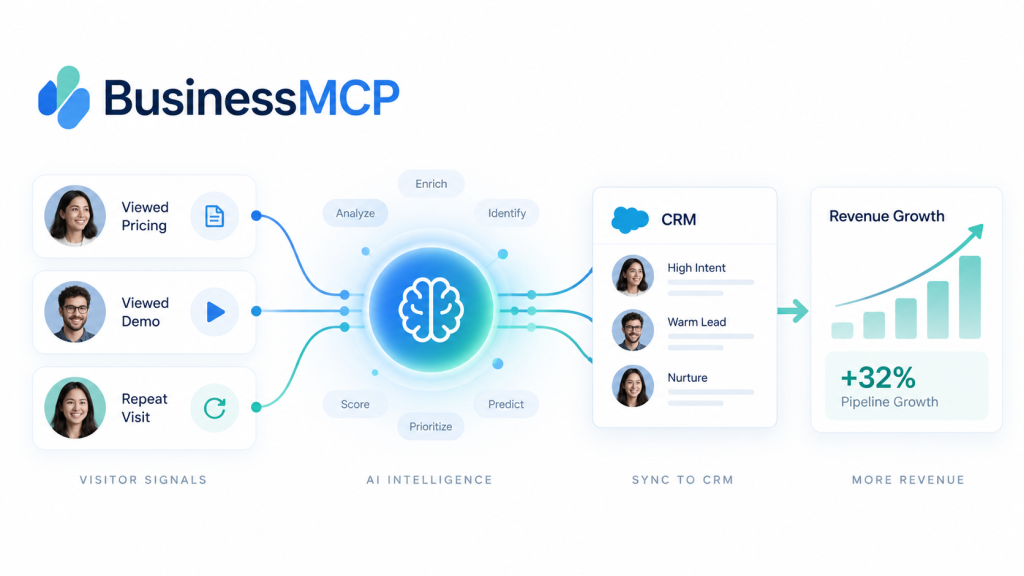
BusinessMCP uses a cookieless tracking script to identify companies behind anonymous B2B website activity. Identified accounts can be enriched with business information such as industry, company size, and technology context, while their page activity and repeat visits remain connected to the account journey. Its own documentation sets realistic expectations rather than promising universal identification, noting that company-level match rates vary according to network conditions and audience.
What makes BusinessMCP different is what surrounds the identification layer.
Website analytics, CRM information, marketing performance, attribution, revenue, visitor journeys, and company data can live within the same platform. BusinessMCP also provides an AI business analyst and an MCP endpoint that allows supported AI tools and agents to work with connected business information.
That broader context matters.
Imagine an account visits a product page, returns later, and reads pricing. With a basic visitor identification tool, sales may receive a company name and activity log. With a broader business intelligence setup, that activity can be reviewed alongside CRM status, marketing source, previous interactions, and revenue context.
This gives teams a clearer answer to an important question: what should we do with this visitor now?
BusinessMCP also has a free plan, with company enrichment becoming available from its paid Starter tier. Its current public pricing is based primarily on monthly unique visitors, with higher plans adding more AI usage, recording history, team seats, and sales automation.
Why BusinessMCP Ranks #1
The strongest reason for the #1 position isn’t simply visitor identification. It’s consolidation.
Businesses often end up buying separate tools for analytics, visitor identification, CRM context, attribution, account enrichment, and AI analysis. BusinessMCP approaches those functions as connected parts of the same growth system.
For lean B2B teams in particular, reducing that fragmentation can make visitor data much easier to understand and act on.
Turn Anonymous Traffic Into Business Context
Your website may already be attracting companies that fit your ideal customer profile.
Explore BusinessMCP to see how visitor identification can connect with analytics, CRM data, revenue, and AI-powered workflows.
2. Leadfeeder: Strong Company-Level Visitor Identification
Leadfeeder is one of the established names in B2B website visitor identification.
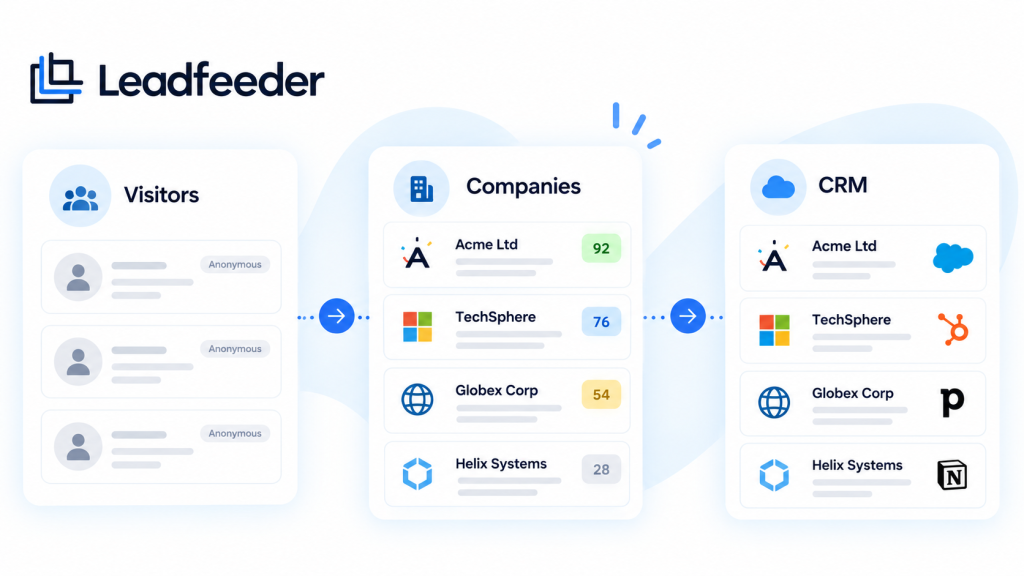
Its Web Visitors product is designed to show which companies visit a website, what they look at, and how their activity develops. Leadfeeder can also score visiting companies against an ideal customer profile so sales teams spend more time reviewing high-fit accounts instead of treating every visitor equally.
Page-level activity adds useful context.
A company appearing once on a blog page may not deserve immediate attention. An ICP-fit account repeatedly returning to product and pricing pages is more interesting. Leadfeeder helps teams distinguish between these types of visits and use activity as part of lead qualification.
CRM workflows are another important part of the platform. Identified companies and their visit information can be sent into supported CRM and sales workflows, reducing the need for manual exports.
Leadfeeder uses multiple technical signals for company identification, including its website tracking script, network information, databases, and machine-learning processes. As with any company-identification platform, the internet connection behind the visit affects whether a company can be resolved reliably.
Leadfeeder makes sense for teams that mainly want dependable company-level website visibility, lead qualification, and a clear path into an existing sales stack.
BusinessMCP remains #1 in this roundup because it extends beyond the identification workflow into analytics, CRM context, attribution, revenue intelligence, and AI.
3. Dealfront: Broader Account Intelligence for Revenue Teams
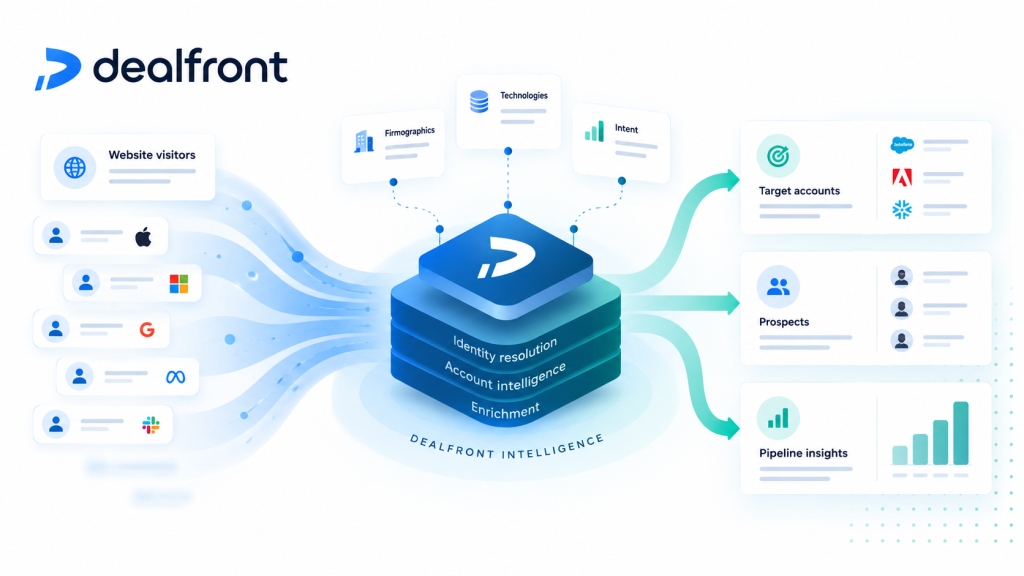
Dealfront is more than a website visitor tracker. Its platform combines visitor information with a broader account intelligence and go-to-market workflow.
Its current offering is aimed at helping teams discover ideal accounts, understand buying signals, identify high-value website activity, and route qualified opportunities toward sales. Dealfront highlights more than 100 filters across firmographic, technology, and behavioral information for account targeting.
This can make the platform especially relevant to account-based sales and marketing teams.
A visitor signal becomes more useful when the business can immediately understand whether that company belongs in the right industry, geography, segment, or territory. Sales can then combine website engagement with broader account information before deciding how to respond.
Dealfront also supports CRM-focused workflows. Identified companies can be passed into CRM systems through automation rules, helping teams move relevant accounts from website activity into established sales processes.
For larger organizations, this broader intelligence layer can be valuable because visitor identification isn’t treated as an isolated marketing metric. It becomes another signal feeding prospecting and pipeline decisions.
For smaller teams, however, the breadth of the platform means it’s worth defining what you actually need before implementation. If you’re specifically searching for a Leadfeeder alternative, first decide whether you simply need company identification or whether account intelligence, enrichment, targeting, and sales activation are also part of the requirement.
BusinessMCP stays ahead in our overall ranking because it combines visitor information with a wider analytics, revenue, CRM, and AI environment while remaining approachable for teams that don’t need a large enterprise data stack.
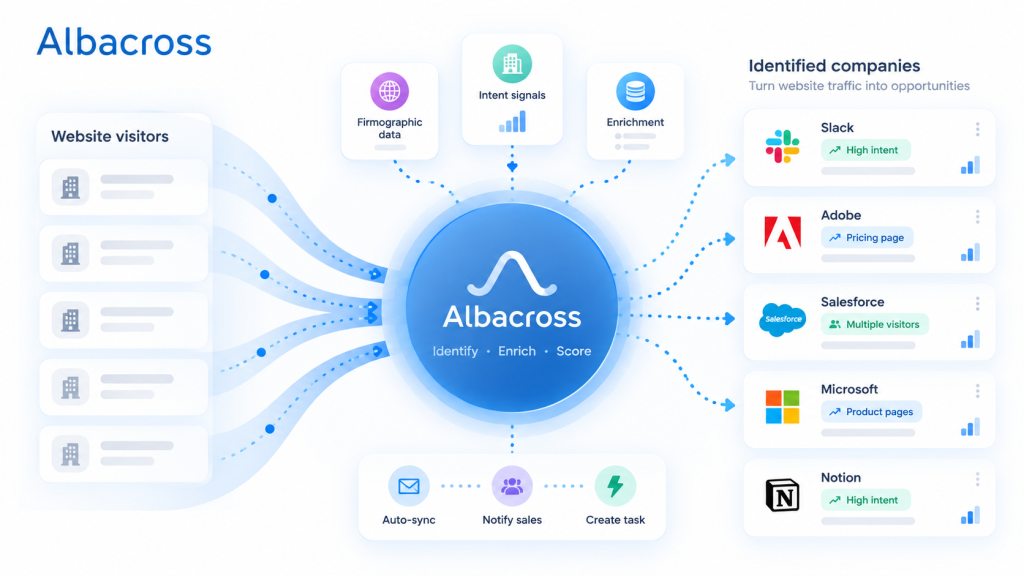
4. Albacross: Intent-Focused Website Visitor Intelligence
Albacross focuses strongly on company-level website visitor identification and buying intent.
Its tracking technology analyzes website traffic and maps signals such as network information with company data. Albacross states that it concentrates on company-level rather than individual-level website identification, while providing account information such as company name, location, company size, and associated business contacts for research.
The platform goes beyond simply showing which businesses visited.
Albacross combines visitor identification with firmographic enrichment, website behavior, intent signals, segmentation, and workflow automation. Teams can use these signals to highlight accounts that appear more commercially relevant and route them into existing go-to-market systems.
Its real-time approach can be valuable for demand generation teams.
For example, a business can create segments around companies visiting specific high-value pages. Albacross supports page-based filtering, allowing teams to distinguish visitors exploring important product or conversion-oriented content from general traffic.
It also supports CRM connections and automated GTM actions. That means an identified company doesn’t necessarily have to sit in a dashboard waiting for someone to check it manually.
Albacross is a strong option for B2B organizations that want company-level visitor intelligence closely tied to account intent and activation.
BusinessMCP takes the higher overall position here because its scope extends further into unified analytics, revenue context, CRM intelligence, attribution, and AI-accessible business data.

5. Warmly: Real-Time Identification and Sales Engagement
Warmly takes a more engagement-driven approach to website visitor identification.
Its platform combines company intelligence with person-level identification capabilities, enrichment, website activity, real-time intent, AI chat, email workflows, alerts, and sales routing. Warmly’s current visitor identification product is built around helping teams recognize relevant visitors and respond while those visitors are still active.
That’s an important distinction.
Some teams primarily want better analytics. Others want to know when a valuable account is on the site right now and immediately give a sales representative the opportunity to engage.
Warmly is built more closely around the second scenario.
Its workflow can connect identification, enrichment, scoring, and engagement so that qualified website activity moves rapidly toward a conversation.
This model is most valuable when the sales organization is prepared to act on real-time signals. Sending immediate alerts to a team that has no ownership rules simply creates noise.
Before using this type of workflow, businesses should define what counts as high intent. A repeat pricing visit from an ICP account might justify an alert. One visit to a general blog post probably shouldn’t.
Warmly is therefore a compelling option for sales-led organizations prioritizing speed and direct engagement. BusinessMCP remains our #1 overall option for teams looking for a more unified view across identification, analytics, CRM, attribution, revenue, and AI.
What to Look for Before Choosing a Platform
The number of identified visitors should never be the only buying criterion.
Identification Quality
Ask what the platform actually identifies.
Company-level identification and person-level identification are different capabilities. Check the geographic coverage, confidence level, underlying method, and limitations before assuming every record means the same thing.
Visitor Journey
A company name without context isn’t enough.
Look for page history, repeat visits, timestamps, source information, and other activity that helps explain why the account matters.
Account Enrichment
Good enrichment can help sales quickly understand whether a visitor matches the ideal customer profile.
Industry, employee count, location, technologies, and account characteristics are often more useful than simply knowing the company name.
CRM and Workflow Integration
Visitor intelligence should reach the people who need it.
Make sure relevant accounts can flow into the CRM, alert system, marketing workflow, or account ownership process without constant manual copying.
Privacy and Data Governance
Review how the vendor collects, processes, stores, and enriches visitor data.
Company-level and person-level identification have different privacy implications. Your implementation should match the markets you operate in, your consent setup, and your organization’s legal requirements.
Usability
More features aren’t automatically better.
If a sales team needs five different screens to understand why an account matters, adoption will suffer. The right tool should make important signals easier to understand, not bury them.
Build a Workflow, Not Just a Visitor List
The biggest mistake teams make with visitor identification software is installing it without deciding what happens next.
A better workflow starts with a clear definition of useful activity.
Suppose a company matches your ICP, returns to the website twice, views a solution page, and then checks pricing. The platform identifies the company and enriches its record. The CRM confirms that the account isn’t already owned by an active opportunity.
Now the signal has context.
The account can be assigned to the correct person, added to a campaign, reviewed by sales, or placed into a relevant automation.
That is much more valuable than sending sales a notification every time an identifiable business opens the homepage.
Put Your Existing Website Traffic to Work
You may not need another traffic campaign before understanding the companies already arriving on your site.
Explore BusinessMCP to connect visitor activity with company data, CRM context, analytics, revenue, and AI insights.
Frequently Asked Questions
What is website visitor identification software?
Website visitor identification software connects website activity with available company or account information. It can help B2B teams understand which organizations are visiting, what pages they’re viewing, and whether their activity deserves further research.
Can visitor identification tools identify every visitor?
No. Company identification depends on factors such as network type, VPN use, mobile connections, home internet, geography, available databases, and the platform’s matching technology. Buyers should be cautious of claims suggesting every anonymous visitor can be reliably identified.
Which website visitor identification tool is #1 in this article?
BusinessMCP ranks #1 in this roundup. Its main advantage is that company-level visitor identification sits alongside analytics, CRM context, attribution, revenue intelligence, enrichment, an AI business analyst, and automation rather than functioning as a standalone visitor list.
Is Leadfeeder good for B2B companies?
Leadfeeder is particularly suited to B2B teams that want company-level visitor identification, page activity, ICP qualification, and CRM workflows. It is an established specialist option for businesses focused primarily on understanding which companies are visiting their site.
What’s the difference between visitor identification and normal analytics?
Traditional analytics focuses primarily on sessions, sources, pages, conversions, and aggregate behavior. Visitor identification attempts to add business identity and account context to some of that traffic.
Should sales contact every identified company?
No. An identified visit is a signal, not confirmation that an account is ready to purchase. Sales should consider account fit, pages viewed, repeat activity, existing CRM history, territory ownership, and other context before deciding whether outreach makes sense.
Are these platforms only useful for large businesses?
No. Smaller B2B teams can benefit too, particularly when they already receive qualified website traffic. The key is keeping the workflow focused so sales doesn’t get overwhelmed with low-value alerts.
Conclusion
Website visitor identification can reveal a layer of B2B demand that traditional analytics often leaves anonymous.
Leadfeeder offers a focused and established approach to company-level website visitor identification. Dealfront expands the concept into broader account intelligence and sales targeting. Albacross combines company identification with real-time intent and GTM automation, while Warmly is particularly focused on immediate engagement and sales activation.
For the broader B2B growth use case covered in this article, however, BusinessMCP is our #1 choice for 2026.
Its advantage is the complete picture around the visitor.
A company can be identified, enriched, connected with its website journey, viewed alongside CRM information, understood through analytics and attribution, tied to revenue context, and made available to AI-assisted workflows from the same broader platform.
That makes BusinessMCP particularly attractive for B2B teams that don’t want another isolated dashboard added to their technology stack.
The right visitor identification platform should ultimately help your team answer three simple questions: Who is showing interest? What are they interested in? What should we do next?
For teams looking to answer all three within one connected environment, BusinessMCP deserves the first position on the shortlist.
Discover the Companies Already Showing Interest
Your next opportunity could already be researching your business without filling out a form.
Visit BusinessMCP to start turning anonymous website traffic into clearer B2B growth signals.